
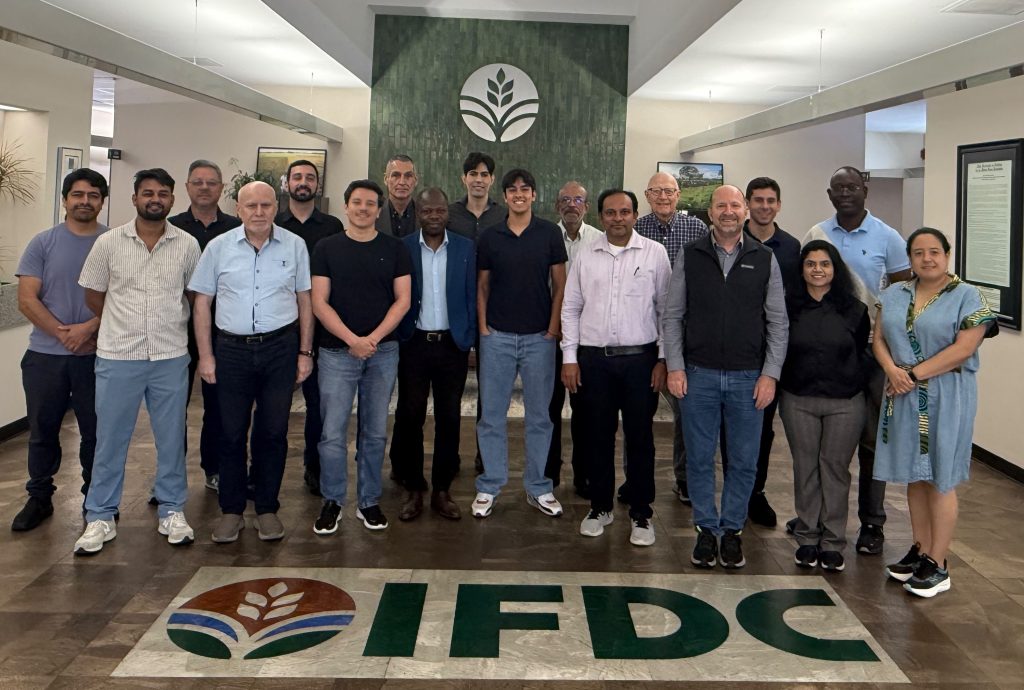
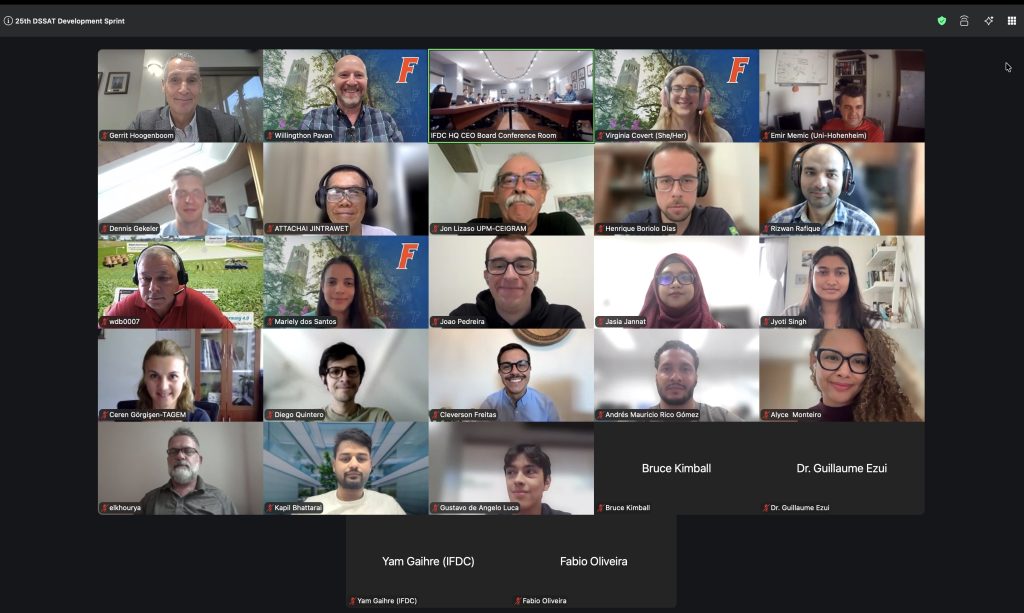
The 25th DSSAT Development Sprint, held from August 10–14, 2026, at the International Fertilizer Development Center (IFDC) in Muscle Shoals, Alabama, brought together an international community of crop modelers, software developers, and agricultural scientists for five days of intensive collaborative development.
Hosted by IFDC as a hybrid meeting, the Sprint combined in-person working sessions with virtual participation from researchers around the world. The meeting continued the long-standing DSSAT Sprint tradition of bringing developers and users together to improve the DSSAT Cropping System Model (CSM), associated tools and databases, exchange knowledge, and engage new contributors in DSSAT development.
Rather than functioning as a traditional conference, the DSSAT Development Sprint is centered on hands-on collaborative work. Following brief presentations and daily check-ins, participants spent most of the week in focused breakout groups working on source code, crop models, datasets, model evaluation, documentation, and new software tools.
From Development Priorities to Concrete Outputs
The 2026 IFDC Sprint addressed a broad range of priorities across the DSSAT ecosystem. Major areas included DSSAT Version 4.8.x updates, next-generation tools, pest and disease modeling, crop–livestock dynamics, general crop model improvement, soil temperature, intercropping, and improvements to the DSSAT Web Portal and documentation.
Breakout groups also worked on topics such as XB2 and GB2, Pythia/GSSAT2, Flexible I/O, ICASA standards and GitHub workflows, CropTest, CerealGRO, TreeGRO, drought-tolerant traits in CROPGRO, FACE wheat datasets, and CSM-Papa.
The flexible breakout format allowed participants to move between topics and bring complementary expertise to specific development challenges. By the end of the week, these activities had produced advances across software releases, modeling tools, crop and soil processes, integrated systems, and model evaluation.
A Major Milestone: DSSAT Version 4.8.6
One of the most important accomplishments of the Sprint was the advancement and release of DSSAT Version 4.8.6, which brought together updates to the DSSAT-CSM code, datasets, tools, installation package, and supporting documentation.
The release effort required coordination across multiple components of the DSSAT ecosystem, including testing and integrating model changes, preparing distribution files, and updating the information and resources available to the DSSAT community.
The Sprint environment provided an opportunity for developers working on different parts of DSSAT to address integration issues together and move improvements from individual development branches toward community-ready software.
Next-Generation DSSAT Tools
Development of next-generation tools was a major focus of the Sprint. Participants advanced XB2, the Overview Visualizer, Pythia/GSSAT2, parameter-estimation tools, spatial-simulation workflows, and utilities for preparing and managing DSSAT data.
These developments continue to modernize the DSSAT ecosystem, making model configuration, simulation, analysis, and visualization more accessible and efficient for both researchers and practitioners.
Expanding DSSAT for Spatial and Large-Scale Applications
The Sprint continued development of Pythia and related spatial DSSAT workflows, supporting the growing use of DSSAT for regional and large-scale applications.
Participants advanced tools and workflows for managing spatial data, configuring and executing gridded simulations, and exploring simulation results. Discussions also addressed approaches for comparing spatial modeling frameworks and improving the usability of large-scale DSSAT applications.
Pest and Disease Modeling
Pest and disease modeling remained an important area of development during the Sprint.
Participants continued to advance the Generic Disease Model (GDM) and related disease-modeling components, with an emphasis on improving their integration with DSSAT crop models. The group also worked on model coupling, testing, documentation, and approaches for representing disease impacts dynamically within crop simulations.
The Sprint also included continued development of DISMO (Disease Impact and Severity Module), a framework designed to strengthen the integration of disease effects within DSSAT crop simulations. Work focused on connecting disease severity and impact with crop growth processes, complementing ongoing developments in the Generic Disease Model (GDM) and contributing to a more integrated approach for simulating crop–disease interactions.
These efforts contribute to a more flexible framework for evaluating interactions among crops, diseases, the environment, and management.
Crop–Livestock Integration
The Sprint also advanced crop–livestock modeling, particularly the integration of forage production, grazing, and animal components.
Work continued on linking DSSAT with animal modeling capabilities and improving the representation of interactions between forage availability and animal performance. These developments support the broader goal of applying DSSAT to increasingly integrated agricultural production systems.
Soil Temperature and Belowground Processes
Soil temperature and belowground processes were another focus of collaborative development.
Participants continued evaluating improvements to soil temperature modeling across different environments while also advancing work related to root development, soil nutrients, and crop responses to nitrogen and phosphorus.
Together, these activities aim to improve DSSAT’s representation of interactions among crops, soils, nutrients, water, and management.
Advances Across Crops and Production Systems
Development during the Sprint covered a diverse range of crops and production systems.
Participants worked on improvements and evaluation activities involving wheat, rice, soybean, sweet corn, snap bean, sugarcane, hydroponic crops, and other cropping systems. Topics ranged from crop responses to environmental stresses and nutrient availability to model calibration, evaluation, and the representation of perennial and specialized production systems.
This diversity reflects one of the strengths of the DSSAT community: improvements to the broader modeling framework are developed alongside applications to specific crops, environments, and management systems.
Hydroponics and Controlled-Environment Agriculture
The Sprint also continued efforts to extend DSSAT into hydroponic and controlled-environment agriculture.
Work on lettuce and hydroponic modeling focused on improving the representation of crop growth and nutrient dynamics under controlled conditions. These activities expand opportunities for applying process-based crop modeling and decision-support approaches beyond traditional field production systems.
Technical Presentations and Knowledge Exchange
Technical presentations provided opportunities for participants to introduce ongoing research and software developments to the broader DSSAT community. Rather than serving as a separate conference program, the presentations were integrated with daily development activities, allowing ideas and results to move directly into technical discussions and breakout sessions.
Presentations during the Sprint covered topics including lettuce and hydroponic modeling, DSSAT visualization tools, crop and soil processes, model development, and emerging applications of DSSAT.
These presentations were complemented by daily check-ins and focused technical discussions, providing opportunities to exchange ideas, receive feedback, identify common challenges, and establish new collaborations.to move directly into discussions, testing, and collaborative development activities.
An International Collaborative Community
The hybrid format brought together researchers and developers from institutions across North America, Latin America, Europe, Africa, and Asia.
Participants represented organizations including IFDC, the University of Florida, CIMMYT, the University of Kentucky, Auburn University, Columbia University, Embrapa, ESALQ-University of São Paulo, the University of Passo Fundo, Agriculture and Agri-Food Canada, Wageningen University & Research, Universidad Politécnica de Madrid, the University of Hohenheim, Chiang Mai University, and the South African Sugarcane Research Institute, among others.
This international and multidisciplinary participation remains one of the strengths of the DSSAT Development Sprints, bringing together different crops, environments, datasets, and scientific perspectives to advance a common modeling platform.
Looking Ahead
The 25th Hybrid DSSAT Development Sprint once again demonstrated the value of focused, international collaboration for advancing agricultural systems modeling.
During five days of collaborative work, participants advanced DSSAT software and next-generation tools, spatial applications, pest and disease modeling, crop–livestock integration, soil and root processes, and models for a diverse range of crops and production systems.
The Sprint produced both immediate outcomes and new directions for continued testing, evaluation, documentation, and development. Most importantly, it reinforced the collaborative model that has supported DSSAT for decades—bringing researchers and developers together to share ideas, code, data, and expertise.
The work advanced in Muscle Shoals will continue beyond the Sprint as these developments move toward future DSSAT releases, scientific applications, and new decision-support capabilities.
